Diameter Signaling Controller (DSC)
What Is a Diameter Signaling Controller?
In today's telecom landscape, effective signaling management is essential for 4G and 5G networks. This is why modern Diameter Signaling Controllers (DSCs) provide the cloud-native scalability needed to handle massive signaling traffic.
The technology is vital for IP interconnect service providers and MNOs (Mobile Network Operators) looking to enhance service reliability. Not only that, but cloud-native scalability also reduces operative costs while increasing automation across the board.
In this article, we'll focus on the term diameter signaling controller and what it implies. We'll talk about its direct benefits for network providers as well as integral elements. By the time you're done reading this post, you should have a much better understanding of this technology and what it entails.
What is a Diameter Signaling Controller (DSC)?
With DSC, service providers are able to tackle common performance issues related to Diameter signaling. Most notably, businesses are able to scale their signaling traffic through cloud-native technology.
Within this environment, DSCs are usually deployed using containerized microservices architectures. This allows businesses to dynamically scale their signaling traffic and address IMS and LTE interoperability challenges across distributed, cloud-based systems.
Diameter signaling controller represents the newest industry-standard protocol utilized for exchanging accounting, authorization, and authentication information within IMS networks as well as LTE networks. DSC is a step forward compared to Lightweight Directory Access Protocol (LDAP) and Remote Authentication Dial-In User Service (RADIUS).
Most importantly, with DSC, you ensure more flexible and secure transport of mobile data within a core network. It's worth noting that Diameter is used by all sorts of network functions, including PCRF or Policy and Changing Rules Function, OCS or Online Charing Systems, and HSS or Home Subscriber Server.
Why Diameter Signaling is Crucial?
Diameter signaling controller DSC provides several crucial benefits for providers:
Enhances Network's Throughput
With these controllers, you're able to increase and optimize the general network throughput. The technology provides support for both dynamic and static overload handling. As if that wasn't enough, you can address signaling peaks by relying on its sophisticated algorithms.
Provides Stable and Secure Product
Signaling is a vital part of any core network. These are robust products that provide the utmost security to your networks while also boasting advanced capabilities and control. This makes them vital for HTTP networks and Diameter.
Shows You What's Happening in Network
Monitoring is one of the less emphasized features of these controllers. These solutions allow you to track multiple network elements and assess the situation on the spot. Most importantly, DSC allows you to keep tabs on your signaling traffic without investing enormous resources.
Components of Diameter Signaling
Diameter signaling controller has three main parts, which can be used in any combination regardless of distributed or single architecture. Specifically, DSC consists of Diameter Routing Agent (DRA), Diameter Edge Agent (DEA), and Interworking Function.
DRA is vital as it provides scalable centralized message routing. The action occurs within a multinode, multivendor environment taking into account providers LTE and IMS core. On the other hand, we use DEA to ensure authorization, authentication, and subscriber policy are exchanged safely within the LTE network.
Lastly, we also need to mention Interworking Function. With it, modern 4G and 5G network elements are to work in conjunction with 3G and 2G networks, signaling standards, and applicable equipment.
Diameter Signaling Controller Applications and Use Cases
There are numerous situations where DSC proves invaluable. Here are some of the most common use cases for this technology:
- Interworking Diameter between legacy for inter PLMN and LTE
- Interworking Diameter between legacy elements inter PLMN and LTE
- OCS/OFCS, PCRF, and HSS home binding intra-PLMN and load balancing
- PCRF and HSS roaming binding inter-PLMN and load balancing
- PCRF and HSS binding and load balancing for non-3GPP access
- PCRF, OCS/OFCS, and HSS load balancing in IMS networks
Diameter Signaling Controller Architecture
For Diameter to work as intended, you need a reliable peer-to-peer architecture. In cloud-native networks, DSCs leverage container orchestration platforms like Kubernetes to manage peer-to-peer communication more effectively.
As a result, this provides agility and improves resource utilization across distributed systems. The end result of this communication format is mesh topology.
With signaling, we're able to power up numerous network elements. Through data exchange, we can track processes such as session management, device tracking, session tracking, and data usage. Each time a person accesses their phone or mobile app, they exchange numerous Diameter messages without even realizing.
As smartphones become more and more common, the total Diameter signaling traffic starts ramping up. Interestingly enough, many providers have struggled with Diameter signaling storms, which led to massive outages within respective networks. By relying on DSC, communication providers are able to tackle performance and scalability issues that would otherwise hinder their service quality.
Many providers utilize Diameter Signaling Controllers as a gateway for Diameter IWF (Interworking Function). With it, they ensure protocol mediation and routing functions for the signaling. Diameter Signaling Controller breaks down mesh topologies into simpler topologies, thus ensuring enhanced management and scalability.
The Future of Diameter Signaling Controllers
Based on the current data and practical cases, the DSC market has enormous potential. Many providers see the potential and have no trouble investing in infrastructure development. The progress within the field is characterized by the rise of new technologies, including network slicing and edge computing, each of which has a vital place within the communication tech hierarchy.
Cloud-native solutions, such as Titan.ium Platform, are the best example of how DSCs will operate in the future. These platforms are especially great for companies looking to modernize their 4G infrastructure and combine it with modern 5G tech.
After implementing the tech, the users will be able to enjoy the benefits that come with topology hiding, message modification, and session binding. Not only will this improve the level of security, but it will also allow previously incompatible data formats to work together.
According to general forecasts, the entire market is supposed to rise by a 7.1% CAGR rate. Optimistic estimates tell us that DSC will reach $1.6 billion by the year 2025. So, if you were looking to invest in this technology, this would be the right time to do just that.

The Challenge
Evolved packet core (EPC) networks provide mobile data services to 2G, 3G, and 4G subscribers in parallel. Alongside these networks, many operators are deploying advanced policy control solutions and IP multimedia subsystem (IMS) networks in order to create new service offerings, such as Voiceover- LTE (VoLTE) and Voice-over-WiFi (VoWiFi), and to optimize their network core. The emergence of 5G networks adds yet another network variant to the mix.
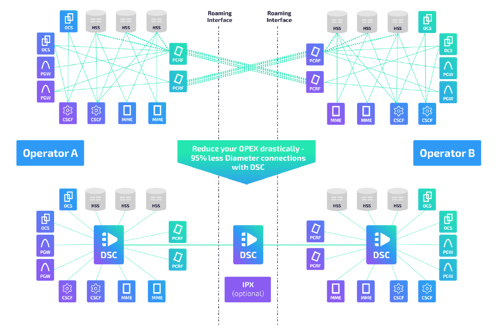
All these networks rely extensively on internode communication carried over the Diameter protocol. With many dozens of connected nodes, a mesh of point-to-point connections is expensive, error prone and difficult to both administer and troubleshoot.
An efficient and centralized Diameter routing solution is needed to streamline and simplify core node connectivity, transforming an ever-growing n-way mesh into an easily understood and maintained hub and spoke architecture.
Diameter Signaling Controller Business Benefits
- Centralized, simplified solution to network Diameter connectivity.
- Simplifies, reduces OPEX and increases network reliability.
- Supports routing, rate limiting, screening and SLA enforcement.
- Advanced features include message transformation and topology hiding.
- Message forking supported for inbound and outbound messages.
- Deployed on field hardened Titan platform.
By deploying Titan.ium’s Diameter Signaling Controller (DSC), operators can realize an efficient and centralized Diameter routing solution, streamlining and simplifying core network connectivity and transforming what would have been an ever-growing complexity into an easily understood and maintained hub and spoke connection architecture. This simplifies connectivity, reduces OPEX and increases network reliability.
The Diameter Signaling Controller does all this by providing capabilities that transform, forward, route, and load balance Diameter signaling traffic within 2G, 3G, LTE, and IMS networks. In combination with its Diameter screening functions, the DSC fully protects the Diameter network, an especially important asset for demanding LTE roaming use cases.
Finally, the DSC's interworking capabilities, such as preventing DoS attacks and enforcing SLAs between operators, provide very important protections for LTE Roaming and WiFi Offload scenarios.
The Titan.ium Diameter Signaling Controller Solution

The DSC provides capabilities that transform, forward, route, and load balance Diameter signaling traffic within 2G, 3G, LTE, and IMS networks. In combination with Diameter screening functions, these capabilities fully protect the Diameter network, especially critical for versatile LTE roaming use cases. The resulting simplification of Diameter routing in the core network reduces complexity, increases reliability and drives down OPEX support costs.
Depending on its configuration, the DSC can seamlessly act as a Diameter Relay, Proxy, Redirect, and Translation Agent per RFC 6733 and as Diameter Edge Agent per GSMA IR.88.
To keep track of all processed Diameter traffic for logging and accounting purposes, the DSC can be configured to provide versatile, fully user-configurable Transaction Detail Records (TDRs).
The DSC makes full use of the flexible Diameter protocol stack of the Titan platform. Furthermore, the DSC utilizes the highly scalable in-memory Titan databases for capabilities like subscriber-specific redirection, session binding and topology hiding. Using the advanced Titan database technology, operators can replicate session and topology hiding data across all DSC nodes. Furthermore, the Diameter Signaling Controller supports configurable and rule-based message forking to one or more destinations for the Diameter messages that the DSC processes.
A key advantage of the DSC is its ability to co-locate its Diameter functions with SS7/STP, SIP, and ENUM/DNS services on a common Titan platform, employing Titan’s dynamic service chaining mechanisms to provide truly integrated services. The resulting Titan solution radically simplifies signaling, control, and routing in the network.
Diameter Signaling Controller Key Capabilities
Diameter Connectivity
In accordance with RFC 6733 and RFC 6737, the Titan.ium Diameter Signaling Controller can be connected to Diameter client and server peers in a highly flexible and secure fashion.
- Support of IPv4 and IPv6 in parallel via different connections.
- Support of TCP in parallel via different connections.
- Support of SCTP.
- Support of optional IPsec encryption for TCP.
- Support of passive and active modes of operation. Via per Diameter connection configuration, the DSC can passively wait for connection establishment requests from other peers or actively try to establish Diameter connections itself.
Diameter Screening Function
Provides advanced network security and interworking.
- Thorough message inspection and access control.
- Flexible use of centrally provisioned white, gray, and blacklists.
- Versatile logging of message parameters and screening actions.
Diameter Transformation Function
Provides seamless integration in legacy networks.
- Highly flexible inbound and outbound message transformation.
- Transformation of Diameter answers based on the corresponding request.
- Bit setting or unsetting of feature bits.
- Powerful stateless and stateful topology hiding.
Diameter Routing Function
Provides optimized routing and traffic distribution.
- Versatile and fully configurable request routing and accounting.
- Contextual and deterministic load balancing.
- Compete session management and session binding.
Diameter Redirect Function
Supports versatile subscriber-based services.
- Identity and subscriber individual routing.
- Flexible use of Titan databases for routing decisions.
- IMS Subscription Locator Function (SLF).
Diameter Accounting Function
Provides flexible generation of accounting records.
- Use of pre-defined and user-defined information elements.
- Use of user-defined accounting record templates.
- Accounting data anonymization for user privacy control.
Diameter Message Forking Function
Provides message copying to one or more destinations.
- Ability to individually copy every inbound and outbound Diameter request and answer.
- Configurable inbound and outbound peer-based triggers, where parameter-based rules can further filter every trigger.
- Configurable list of peers or peer-groups which the system sends Diameter messages to and where a parameter-based rule can further filter each peer or peer group.
Carrier Grade Platform
Brings telecom-grade reliability to Diameter signaling
- The DSC is a telco-grade, real-time signaling element built on Titan.ium’s carrier-grade, field-hardened Titan platform.
- The Titan platform enables a comprehensive Diameter Signaling Controller solution using active Titan DSC nodes that can be geographically distributed across the network.
- This approach is fully compliant to the SDN/NFV security paradigm of specialized signaling controllers per local application instance.